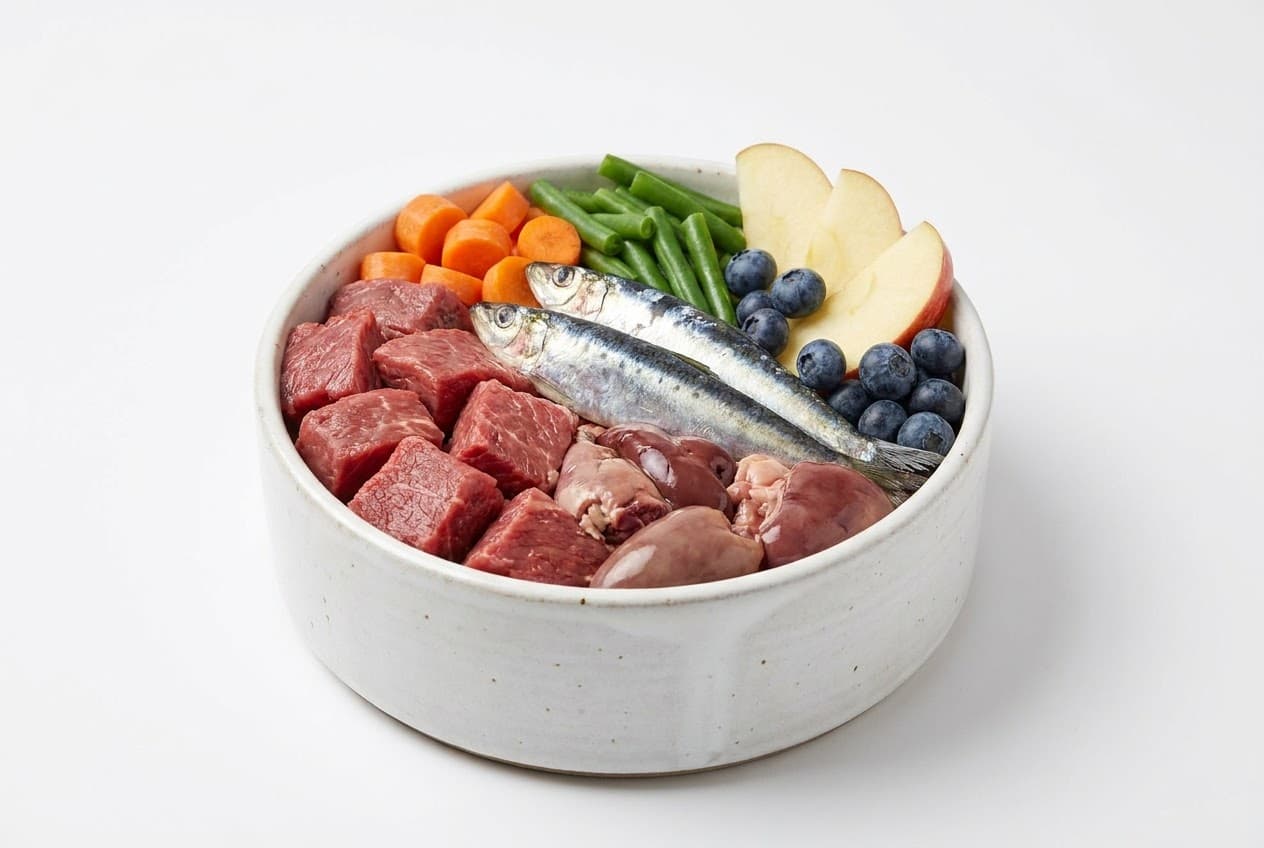

Walk into any pet shop or scroll through any dog owner forum and you will meet passionate believers in raw feeding. The idea has an undeniable pull: feed your dog what nature "intended," skip the ultra-processed kibble, and watch your companion thrive with a glossier coat, cleaner teeth, and more energy. The most popular version goes by the acronym BARF, which stands for both "Biologically Appropriate Raw Food" and "Bones And Raw Food," a feeding philosophy popularised by Australian veterinarian Ian Billinghurst in the 1990s. It typically combines raw muscle meat, organ meat, raw edible bones, and sometimes vegetables, fruit, and supplements.
The narrative is appealing. But appeal is not evidence. So what does the science actually say? The honest answer is that BARF is neither a miracle nor pure marketing. It sits somewhere in between, and the gap between what is claimed and what has been proven is wide. Here is a clear look at both sides.
What raw feeding may genuinely offer
It would be unfair to dismiss raw feeding outright, because a few of the claims do have some scientific footing. The most solid one is digestibility. Controlled feeding studies have shown that dogs digest raw and lightly cooked diets very efficiently, often more efficiently than typical extruded kibble, and that they tend to produce smaller, firmer stools as a result [2]. Owners frequently report that their dogs find raw food highly palatable and eat it eagerly, and raw diets do measurably shift the gut microbiome, although whether those shifts are good, bad, or neutral for long term health remains unclear [2].
Other popular claims, such as shinier coats, better breath, higher energy, and improved overall vitality, are much weaker. When veterinary nutritionists reviewed the available literature, they found that most of these benefits rest on owner testimonials and anecdote rather than on controlled studies measuring actual health outcomes [1]. That does not mean the reports are all imaginary. It means that no one has yet demonstrated, in a rigorous trial, that a balanced raw diet produces healthier or longer lived dogs than a good conventional diet. Absence of proof is not proof of absence, but for a decision about your dog's daily food, it matters that the headline benefits are largely unverified.
The nutrition problem: balance is genuinely hard
Here is where enthusiasm most often collides with biology. A raw diet is only as good as its recipe, and getting the recipe right is much harder than it looks. In one German study that calculated the nutrient content of 95 home prepared raw rations, roughly 60 percent had major nutritional imbalances, including the wrong ratio of calcium to phosphorus, and shortfalls or excesses of key minerals and vitamins [3].
The calcium to phosphorus balance deserves special attention. Muscle meat is rich in phosphorus but poor in calcium, so a diet built mainly on meat without the right amount of bone or a calcium source can starve the body of calcium. In growing puppies and in dogs fed meat only rations, this can trigger a condition called nutritional secondary hyperparathyroidism, in which the body strips calcium from the skeleton. A 2024 case series described four dogs that developed neurological problems traced back to exactly this kind of imbalance after being fed an exclusive diet of raw meat [4]. Deficiencies in taurine, vitamin D, zinc, copper, and vitamin A have also been documented in raw fed animals [1][3]. None of this means raw diets are impossible to balance. It means that doing so reliably requires formulation expertise that most home recipes, and even some commercial products, simply lack.
The germ problem: contamination is well documented
The best documented risk of raw feeding is microbiological. Raw meat is a natural home for bacteria, and freezing does not sterilise it. When researchers in the Netherlands tested 35 commercial frozen raw diets from eight brands, the results were concerning: Listeria monocytogenes in 54 percent of products (the cause of listeriosis, which can bring fever, vomiting, and diarrhoea and, in severe cases, blood poisoning, and which is especially dangerous to pregnant women and people with weakened immune systems), other Listeria species in 43 percent, E. coli O157:H7 in 23 percent (a Shiga toxin producing strain that dogs often carry without appearing ill, but which has been traced from raw pet food to serious human illness, including bloody diarrhoea and kidney failure), and Salmonella in 20 percent (the cause of salmonellosis, with vomiting, fever, and diarrhoea in affected dogs, although many infected dogs stay healthy while still shedding the bacteria to the people around them) [5][11]. A United States Food and Drug Administration study that surveyed a range of commercial pet foods found Salmonella and Listeria overwhelmingly in the raw products rather than in cooked kibble [6].
The concern is not only for the dog. Dogs can carry and shed these bacteria in their stool even when they show no signs of illness, and the pathogens can then reach people through handling the food, cleaning bowls, or ordinary contact with the dog [1][5]. That is why the risk is considered highest in households with infants, elderly people, pregnant women, or anyone with a weakened immune system. Raw meat can also carry parasites such as Toxoplasma and Sarcocystis, adding another route of exposure [5].
The antibiotic resistance problem: the risk people overlook
If contamination is the familiar risk, antibiotic resistance is the emerging one, and arguably the most serious from a public health point of view. A 2024 study from the United Kingdom compared the stools of 193 dogs fed raw diets with those of 239 dogs fed conventional diets. Dogs on raw food were significantly more likely to shed E. coli resistant to critically important antibiotics, including resistance to third generation cephalosporins, ESBL producing strains, and multidrug resistant strains [7]. Statistical modelling confirmed that feeding raw was itself a major risk factor, independent of other lifestyle factors [7].
This matters because the same close bond that makes dogs wonderful companions, sharing beds, licking hands and faces, also creates an easy path for resistant bacteria to move from pet to person [7]. In an era when antibiotic resistance is one of the leading threats to human medicine, turning the family dog into a quiet reservoir of resistant bugs is not a trivial side effect.
What about the bones?
Bones are central to the BARF idea, and they come with their own trade off. On the positive side, one small study in Beagles found that gnawing on raw beef bones substantially reduced dental tartar, with reductions ranging from roughly 35 to 88 percent over several weeks, and without fractured teeth or obstructions in that particular group [8]. On the negative side, that study was small and short, and the broader veterinary experience is full of the opposite outcome: cracked and fractured teeth, bone fragments lodged in the throat or intestines, and blockages that require surgery. Veterinary nutrition authorities generally conclude that whatever modest dental benefit bones provide does not outweigh the risk of painful and expensive injuries [10].
What the experts recommend
Professional bodies have looked at this balance of evidence and landed on a cautious position. The American Veterinary Medical Association discourages feeding raw or undercooked animal source protein to dogs and cats, citing the documented contamination risk to both pets and people [9]. The World Small Animal Veterinary Association's Global Nutrition Committee goes further, stating that there is currently no properly documented evidence of health benefits from raw meat diets, while the risks are well documented, and it recommends that such diets not be fed to dogs and cats [10]. These are not fringe opinions; they represent the mainstream veterinary consensus.
So, hype or not?
The fair verdict is that BARF is over sold rather than fake. Raw diets are highly digestible, most dogs enjoy them, and owner enthusiasm is real. But the marquee health claims remain largely unproven in controlled studies, while three categories of risk, nutritional imbalance, pathogen contamination, and antibiotic resistance, are genuinely well documented in the scientific literature. When benefits are uncertain and risks are established, caution is the reasonable default.
That does not have to mean "never." If you feel strongly about feeding raw, you can lower the risks considerably. Work with a board certified veterinary nutritionist to build a recipe that is actually balanced, rather than trusting a homemade formula or online recipe [1][3]. Favour commercial products that use a validated pathogen reduction step such as high pressure processing. Practise strict kitchen hygiene, wash hands and bowls thoroughly, and reconsider raw feeding entirely if anyone in your home is very young, elderly, pregnant, or immunocompromised [5][9]. Be careful with whole bones. And remember that gently cooked, properly balanced fresh diets can deliver much of the palatability and digestibility that draws people to raw, without the same load of live bacteria.
In short, your dog does not need a raw diet to thrive. If you choose one anyway, choose it with your eyes open, your recipe checked, and your kitchen clean.
References
- Freeman LM, Chandler ML, Hamper BA, Weeth LP. Current knowledge about the risks and benefits of raw meat-based diets for dogs and cats. Journal of the American Veterinary Medical Association, 2013;243(11):1549-1558. doi:10.2460/javma.243.11.1549. https://pubmed.ncbi.nlm.nih.gov/24261804/
- Algya KM, Cross TL, Leuck KN, et al. Apparent total-tract macronutrient digestibility, serum chemistry, urinalysis, and fecal characteristics, metabolites and microbiota of adult dogs fed extruded, mildly cooked, and raw diets. Journal of Animal Science, 2018;96(9):3670-3683. doi:10.1093/jas/sky235. https://pubmed.ncbi.nlm.nih.gov/29893876/
- Dillitzer N, Becker N, Kienzle E. Intake of minerals, trace elements and vitamins in bone and raw food rations in adult dogs. British Journal of Nutrition, 2011;106(S1):S53-S56. doi:10.1017/S0007114511002765. https://pubmed.ncbi.nlm.nih.gov/22005436/
- Nowak L, van Loon S, Hagen-Plantinga E, Bergknut N. A Case Series of Four Dogs Presenting with Neurological Deficits Due to Suspected Nutritional Secondary Hyperparathyroidism after Being Fed an Exclusive Diet of Raw Meat. Animals, 2024;14(12):1783. doi:10.3390/ani14121783. https://www.mdpi.com/2076-2615/14/12/1783
- van Bree FPJ, Bokken GCAM, Mineur R, et al. Zoonotic bacteria and parasites found in raw meat-based diets for cats and dogs. Veterinary Record, 2018;182(2):50. doi:10.1136/vr.104535. https://pubmed.ncbi.nlm.nih.gov/29326391/
- Nemser SM, Doran T, Grabenstein M, et al. Investigation of Listeria, Salmonella, and toxigenic Escherichia coli in various pet foods. Foodborne Pathogens and Disease, 2014;11(9):706-709. doi:10.1089/fpd.2014.1748. https://pmc.ncbi.nlm.nih.gov/articles/PMC4152787/
- Morgan G, Pinchbeck G, Haldenby S, Schmidt V, Williams N. Raw meat diets are a major risk factor for carriage of third-generation cephalosporin-resistant and multidrug-resistant E. coli by dogs in the UK. Frontiers in Microbiology, 2024;15:1460143. doi:10.3389/fmicb.2024.1460143. https://pmc.ncbi.nlm.nih.gov/articles/PMC11417003/
- Pinto CFD, Lehr W, Pignone VN, et al. Evaluation of raw beef bones as chewing items to reduce dental calculus in Beagle dogs. Australian Veterinary Journal, 2016;94(1-2):18-23. doi:10.1111/avj.12394. https://pubmed.ncbi.nlm.nih.gov/26814157/
- American Veterinary Medical Association. Raw or undercooked animal-source protein in cat and dog diets (AVMA policy). https://www.avma.org/resources-tools/avma-policies/raw-or-undercooked-animal-source-protein-cat-and-dog-diets
- World Small Animal Veterinary Association (WSAVA), Global Nutrition Committee. Statement on the Risks of Raw Meat-Based Diets. https://wsava.org/wp-content/uploads/2020/05/WSAVA-Global-Nutrition-Committee-Statement-on-Risks-of-Raw-Meat.pdf
- Kaindama L, Jenkins C, Aird H, Stoker K, Byrne L. A cluster of Shiga toxin-producing Escherichia coli O157:H7 highlights raw pet food as an emerging potential source of infection in humans. Epidemiology & Infection, 2021;149:e124. doi:10.1017/S0950268821001072. https://pmc.ncbi.nlm.nih.gov/articles/PMC8161292/