
The internet is full of advice about travelling with dogs. Dog friendly beaches, dog friendly cafés, road trip packing lists for the family retriever. Cats barely get a mention, and when they do, the advice is usually a hastily adapted version of the dog guidance. That is a problem, because cats are not small dogs. They travel differently, they stress differently, and the place that happily welcomes an Italian Greyhound may quietly turn your cat away at the door. If you are thinking of bringing your cat along on your next trip, here is the honest, practical picture, including the pitfalls that rarely make it into the glossy travel blogs.
First question: should your cat come at all?
It is worth starting here, because the most loving answer is often "no." Cats are intensely territorial animals, bonded to the place they live rather than to a roaming group the way dogs are. German animal welfare organisations put it plainly: the best holiday accommodation for a cat is usually its own home, and, unlike a dog, a cat does not need the constant presence of its humans, especially if it lives with a feline companion [1]. For most cats, being removed from their territory is precisely what causes stress, not being apart from you.
This is why the recommended default for a normal holiday is to arrange reliable care at home rather than travelling with the cat. A trusted cat sitter who visits daily to feed, clean the litter tray, and spend time with your cat, or a good boarding cattery (Katzenpension) for longer trips, will usually mean far less stress than a journey to somewhere unfamiliar [1]. It is worth remembering that German shelters fill up every summer with animals abandoned by owners who left the arrangements too late, so booking care early is part of responsible ownership [1].
None of this is an absolute rule. Kittens raised with lots of positive exposure, confident and well socialised cats, and the small but growing number of harness trained "adventure cats" can genuinely cope with, and sometimes enjoy, travel. The right decision depends on your individual cat's temperament, the length of the trip, and how suitable the destination really is. If your cat hides at the sight of the carrier, that is valuable information. If you decide your cat is a good candidate, the rest of this guide is about doing it safely.
The "pet friendly" trap
Here is the single biggest surprise for cat owners: "pet friendly," or haustierfreundlich, very often means "dog friendly." When a hotel or holiday flat advertises itself as pet friendly, the one thing you can reliably assume is that it takes dogs. Whether it accepts cats is a completely separate question, and frequently the answer is no [2]. Travellers regularly report confirming that a property was pet friendly, only to be told at check in that this meant dogs, or that a member of housekeeping is allergic to cats [2].
The confusion is baked into how policies are written. A rule about "pets up to a certain weight" tells you nothing about whether a litter tray is welcome in the room [2]. So the golden rule is simple: never rely on the label. Contact the hotel or the Ferienwohnung owner directly, ask specifically whether cats are allowed, and get the answer in writing. Ask about any extra cleaning fee, whether the cat may be left alone in the room, and any other restrictions, so there are no unpleasant surprises on arrival.
The holiday rental that was never cat-proofed
A hotel room or holiday apartment is designed for humans, sometimes with decorative touches that are actively dangerous to a curious cat. Your own home has been quietly cat-proofed over the years. A rental has not, and this is where owners are most often caught out.
Lilies are the headline danger. Both true lilies (Lilien, Lilium) and daylilies (Taglilien, Hemerocallis) are extraordinarily toxic to cats, and the entire plant is poisonous, including the stem, leaves, flowers, pollen, and even the water in the vase [3]. Eating a small amount of a leaf or petal, or simply licking a few grains of pollen off their fur while grooming, can cause fatal kidney failure in under three days, and the toxin affects only cats, not dogs [3]. A welcome bouquet on the apartment table is a genuine emergency risk. Other common houseplants and cut flowers can also be toxic, so it is worth checking any greenery against a reputable poisonous plant list, and knowing the number of your nearest animal poison service before you travel [4].
Essential oil diffusers are a second, less obvious hazard, increasingly common in rentals marketed as relaxing retreats. Cats lack certain liver enzymes needed to break down the compounds in many essential oils, so these substances can build up and cause toxicity, with the most serious cases leading to breathing difficulty or liver damage [5]. Oils including tea tree, eucalyptus, citrus, peppermint, pine, cinnamon, and wintergreen are among the problem ones, and a plug in or reed diffuser running in a closed holiday flat is exactly the wrong environment for a cat [5]. If you find one, unplug it and ventilate the room.
Then there are the escape and fall risks, and here one hazard is very familiar: the tilt-and-turn window (Kippfenster). A cat that tries to climb out of a window left in the tilted position can slip down into the narrowing gap and become trapped, with serious or fatal consequences [6]. Balconies and unscreened upper floor windows are the other classic danger. Veterinarians even have a name for the resulting injuries: high-rise syndrome. A 2025 study from a Berlin veterinary clinic found that these falls happen most often in summer and at night, frequently while a young cat is playing or chasing something near an open window or balcony edge, and that although most cats survive with prompt veterinary care, falls from higher floors cause the most serious injuries [7]. At home, many cat owners solve this with a cat net (Katzennetz) over balconies and windows [6]. In a holiday rental you usually cannot drill or fix anything to the building without the owner's permission, so favour accommodation where windows close fully or are already screened, keep tilt windows shut, and block balcony access. Before you let your cat loose, also check for gaps behind appliances or under doors through which a frightened cat could bolt and vanish into an unfamiliar neighbourhood.
Getting there in one piece
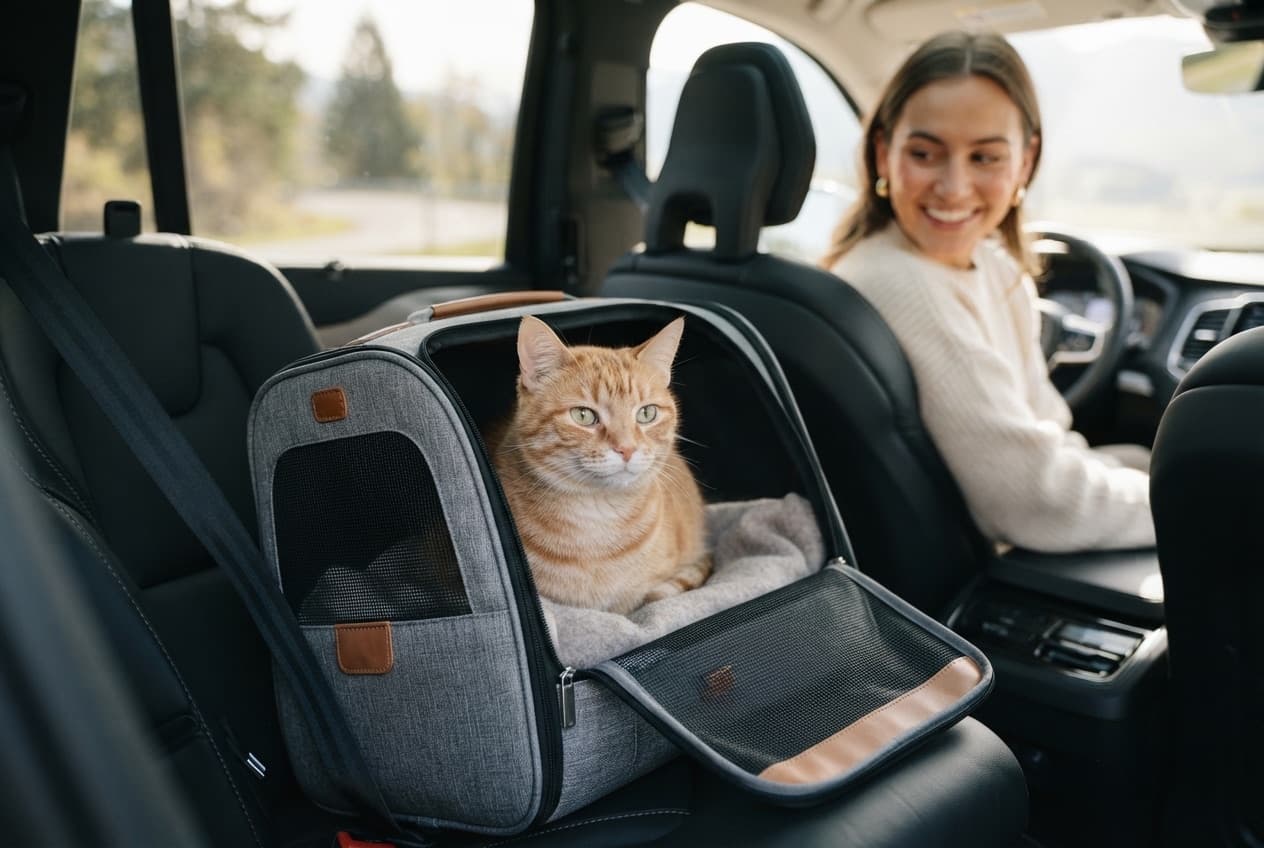
However you travel, your cat should always be secured, never loose in the car. The safest options are a sturdy carrier wedged into the footwell behind a seat or strapped in with a seatbelt, or a well fitted escape proof harness attached to a seatbelt tether [8]. A loose cat is both a distraction and, in a collision, a projectile, and an open door at a service station is all it takes to lose them.
Stress is the other enemy, and a little preparation goes a long way. Get your cat comfortable with the carrier well before the trip, ideally weeks ahead, by leaving it out at home with familiar bedding and treats inside so it becomes a safe den rather than a trap [9]. Line it with something that smells of home, and consider a synthetic feline pheromone spray such as Feliway on the bedding to help your cat feel more secure [9]. For longer journeys, plan for a litter tray and water, keep the car cool and never leave a cat alone in a parked car, and talk to your vet in advance about whether anti nausea or anti anxiety medication is appropriate for your particular cat [9]. Build up to it with a few short practice drives, which tell you a lot about whether the real journey is realistic.
Crossing a border? The EU pet passport comes first
The good news is that travelling within the EU with a cat is relatively straightforward, because it runs on one document: the EU pet passport (EU-Heimtierausweis). Any authorised vet in Germany can issue it, and it is valid for your cat's lifetime as long as the rabies vaccination is kept up to date [10][11].
The core requirements are the same across the EU. Your cat must be microchipped, and it must then be vaccinated against rabies, in that order, because the microchip has to be in place before the vaccination for it to count. Your cat must be at least 12 weeks old for the first rabies vaccination, and you must then wait at least 21 days before travelling [10][11]. Individual countries can have additional rules, and requirements change over time, so always check the current official EU and national guidance, for example the ADAC entry requirements pages, well before you book [11][12].
The pre-booking checklist
Before you commit to a destination or a place to stay, run through this list. If you cannot tick the important boxes, it may be a sign the trip is better done without your cat.
Destination and logistics
- Is the journey short enough that your individual cat can realistically cope with it?
- Have you located a veterinary clinic near the destination, and noted the local emergency vet (Tierärztlicher Notdienst) and an animal poison service number? [4]
- If crossing a border, is your cat's EU pet passport in order, with microchip and a valid rabies vaccination, and are the 21 day and any country specific timelines achievable before you leave? [10][11]
- Is the climate and season suitable, so your cat is never left in a hot car or a hot room?
The accommodation itself
- Have you confirmed, in writing, that cats specifically are welcome, not just "pets"? [2]
- Are there extra fees, and is it acceptable to leave the cat alone in the room, or must it always be with you?
- Do the windows close fully or have secure screens, and can tilt windows and balcony access be blocked? [6][7]
- Can you ask in advance for any lilies or fresh flowers to be removed, and any essential oil diffusers to be switched off? [3][5]
- Is there a quiet space for a litter tray, food, water, and a familiar bed away from foot traffic?
- Are there obvious escape routes or hiding gaps you would need to block on arrival?
What to pack
- Familiar bedding and a favourite toy that smell of home
- Enough of your cat's usual food and litter to avoid sudden changes
- The carrier, harness and lead, bowls, and any medication
- The EU pet passport, microchip details, and a recent photo in case your cat goes missing
The honest verdict
Travelling with a cat is not impossible, and for a well suited cat with a well chosen destination it can work beautifully. But it asks far more planning than travelling with a dog, and it comes with risks that the cheerful pet-friendly label completely hides. For a great many cats, the kindest holiday is the one where they stay in their own territory, in their own home, cared for by a reliable sitter, while you relax knowing they are safe [1]. If you do decide to bring your cat, go in with your eyes open, confirm everything in advance, sort the EU pet passport early, and cat-proof the space the moment you arrive. Your cat cannot read the accommodation listing. That part is up to you.
This article is for general information and is not a substitute for veterinary advice. Talk to your veterinarian before travelling with your cat, especially if your cat is very young, elderly, anxious, or has a health condition, and check the current official EU and German government sources for the rules on your specific route.
References
- VIER PFOTEN (FOUR PAWS) Stiftung für Tierschutz, Germany. Katzenbetreuung im Urlaub (cat care during the holidays). https://www.vier-pfoten.de/unseregeschichten/ratgeber-katze/katzenbetreuung-im-urlaub
- Catster. Are Cats Allowed in Hotels? A Guide to Cat-Friendly Hotels. https://www.catster.com/lifestyle/are-cats-allowed-in-hotels/
- U.S. Food and Drug Administration (Center for Veterinary Medicine). Lovely Lilies and Curious Cats: A Dangerous Combination. https://www.fda.gov/animal-veterinary/animal-health-literacy/lovely-lilies-and-curious-cats-dangerous-combination
- ASPCA. Toxic and Non-Toxic Plants (searchable list). https://www.aspca.org/pet-care/animal-poison-control/toxic-and-non-toxic-plants
- Pet Poison Helpline. Essential Oils and Cats. https://www.petpoisonhelpline.com/uncategorized/essential-oils-cats/
- Frankfurter Katzenschutzverein e.V. Absicherung für Katzen in Wohnung und Haus (securing windows, tilt windows and balconies with cat nets). https://www.katzenschutzverein.de/absicherung-fuer-katzen/
- Candela Andrade M, Slunsky P, Nerlich A, Aguilera-Rojas M, Brunnberg L. High-rise syndrome in cats (part 1): epidemiology and risk factors. Journal of Feline Medicine and Surgery, 2025. doi:10.1177/1098612X251334091. https://journals.sagepub.com/doi/10.1177/1098612X251334091
- GoPetFriendly. Traveling With Cats: Keeping Them Safe in the Car. https://www.gopetfriendly.com/blog/traveling-cats-keeping-them-safe-in-the-car/
- PetMD. How to Get Your Cat Used to Their Carrier (carrier acclimation, familiar bedding, and pheromone use to reduce travel stress). https://www.petmd.com/cat/general-health/how-to-get-your-cat-used-to-their-carrier
- European Commission / Your Europe. EU rules on travelling with pets and other animals in the EU (EU pet passport, microchip, rabies vaccination). https://europa.eu/youreurope/citizens/travel/carry/pets-and-other-animals/index_en.htm
- European Commission, Directorate-General for Health and Food Safety. Travelling with a pet dog, cat or ferret within the EU. https://food.ec.europa.eu/animals/live-animal-movements/dogs-cats-and-ferrets/travelling-pet-within-eu_en
- ADAC. Einreisebestimmungen für Hunde, Katzen und andere Haustiere (entry requirements for pets by country). https://www.adac.de/reise-freizeit/ratgeber/reisetipps/einreisebestimmung-tiere/